
You have 0 items in your cart
In This Guide
- The Short Answer (and the Big Catch)
- Queensland’s Three-Layer Vegetation Framework
- Brisbane City Council — Natural Assets Local Law
- Logan City Council — Vegetation Protection Orders
- Ipswich City Council — Planning Scheme Overlays
- Moreton Bay Regional Council — Vegetation Management Rules
- Scenic Rim Regional Council — Regional Plan Compliance
- Gold Coast City Council Rules
- What Counts as a “Significant” or “Protected” Tree?
- Exemptions — When You Don’t Need a Permit
- The Application Process — Step by Step
- Emergency & Storm-Damaged Tree Removal
- Penalties for Unauthorised Tree Removal
- Why Most Applications Need an Arborist Report
- Common Mistakes Property Owners Make
- Frequently Asked Questions
- Need Help With a Council Application?
It’s the single most common question we field at Dynamic Tree Solutions — and the honest answer is: it depends on which council you live in, the species and size of the tree, and where it stands on your block. The rules across South-East Queensland’s six major council areas aren’t uniform. A tree that’s freely removable in one suburb might trigger a $13,000 fine if removed without approval just a few kilometres away in the next council district.
Want a quick way to work out whether you need permission? Our five-check guide to cutting down a tree in Brisbane walks you through it.
This guide walks you through the council approval rules for tree removal across Brisbane City Council, Logan City Council, Ipswich City Council, Moreton Bay Regional Council, Scenic Rim Regional Council, and Gold Coast City Council. We cover when you need a permit, when you’re exempt, how to apply, what penalties apply for unauthorised removal, and where most property owners trip up.
The Short Answer (and the Big Catch)
For most domestic trees on most suburban Brisbane blocks, you don’t need council approval to remove a tree from your own property. But that simple answer hides three big catches:
- Protected trees — Native species over a certain size, trees on the Significant Tree Register, trees in vegetation protection overlays, and trees on council land all require approval regardless of who “owns” them.
- Property overlays — Your block might sit in a Bushfire Hazard Overlay, Waterway Corridor Overlay, Koala Habitat Overlay, or Vegetation Management Overlay that imposes clearing restrictions on top of the standard council rules.
- State-level rules — Queensland’s Vegetation Management Act 1999 can apply even when councils give the green light, particularly for blocks zoned rural or containing regulated regional ecosystems.
Get it wrong and the penalties are eye-watering — up to $13,345 per tree in BCC, and substantially more if you’ve cleared a protected species or vegetation in a regional ecosystem. The cost of a 30-minute call to your council before you fire up the chainsaw is genuinely zero, and the cost of a fully scoped AQF Level 5 arborist report to support a council application is a tiny fraction of the worst-case fine.
Queensland’s Three-Layer Vegetation Framework
Before we drill into individual councils, it’s worth understanding that tree removal rules in Queensland operate on three stacked layers. Any one of them can be the layer that says “no” — and councils enforce all three.
Layer 1 — Commonwealth (Federal) Rules
The Commonwealth Environment Protection and Biodiversity Conservation Act 1999 (EPBC Act) applies if your removal would impact a listed threatened ecological community, a matter of national environmental significance, or a federally listed species. For most domestic backyards in SEQ, the EPBC Act isn’t triggered — but for rural acreage or properties bordering national parks, it can be the layer that vetoes the entire job.
Layer 2 — State Rules
The Vegetation Management Act 1999 (VMA) regulates clearing on freehold and leasehold land in Queensland. Mapped regional ecosystems, watercourse vegetation, and “category A/B/C/R” mapped vegetation all attract VMA protection — even on freehold blocks. The state’s Regulated Vegetation Management Map (available via Queensland Globe) is the authoritative source for whether your block is affected.
Layer 3 — Local Council Rules
Each SEQ council adds its own layer on top — and this is the layer that catches most suburban property owners. Councils use a mix of Planning Schemes, Local Laws, Vegetation Protection Orders (VPOs), and Significant Tree Registers to control what gets cleared. The next sections walk through each major SEQ council in turn.
Brisbane City Council — Natural Assets Local Law (NALL)
Brisbane City Council manages tree protection through the Natural Assets Local Law 2003 (NALL). Under NALL, you generally need council approval to remove or significantly damage a tree on private property if:
- The tree has a trunk circumference of 400mm or more measured at 1.3 metres above ground (roughly 130mm trunk diameter, or about the size of a basketball)
- The tree is listed on Brisbane’s Significant Tree Register
- The tree is in a Vegetation Protection Overlay on the City Plan
- The tree is on council land or in a council park
NALL applies regardless of species — so a 400mm-circumference camphor laurel (an environmental weed) and a 400mm-circumference native spotted gum are both regulated. We’ve broken down the full BCC process, NALL thresholds, application steps and fees in our dedicated Brisbane City Council tree regulations guide.
Brisbane suburbs we routinely handle NALL applications and removals across include all 190+ Brisbane suburbs — from Forest Lake in the south to The Gap in the west and the suburbs around Wynnum and Capalaba in the bayside east. The NALL thresholds are the same across all of them.
Logan City Council — Vegetation Protection Orders
Logan City Council uses a combination of Vegetation Protection Orders (VPOs) and overlays under the Logan Planning Scheme 2015. Logan does not use a single trunk-size threshold like BCC — instead, the planning scheme triggers approval requirements based on:
- Vegetation Management Overlay — covers significant biodiversity corridors, riparian buffers, and koala habitat areas
- Bushfire Hazard Overlay — paradoxically, can require certain clearing for fire safety while protecting other vegetation
- Mapped regional ecosystems — particularly in the rural-residential acreage suburbs south of Beenleigh
- Trees within state-protected riparian corridors
Logan’s planning scheme overlays vary significantly between suburbs — a Greenbank rural block has very different rules from an inner Logan urban block. We cover Logan-specific application steps in detail in our Logan Council tree regulations hub, which links to suburb-specific guides for Springwood, Beenleigh, Jimboomba, Marsden and others.
Ipswich City Council — Planning Scheme Overlays
Ipswich City Council regulates tree clearing primarily through the Ipswich Planning Scheme 2006, with vegetation overlays that affect significant portions of the city. Approval is generally required where:
- The tree is located in a mapped Vegetation Management Area
- The tree is within a Waterway Corridor overlay
- Removal would impact koala habitat (Ipswich has substantial mapped koala priority areas)
- The tree is a registered specimen under Ipswich’s heritage register
Ipswich’s rural-residential growth corridors — particularly around Ripley, Springfield Lakes, Walloon and Rosewood — have particularly active overlays because of the proximity to remnant koala habitat. Our Ipswich tree services hub covers the Ipswich application process and suburbs in detail.
Moreton Bay Regional Council — Vegetation Management
Moreton Bay Regional Council operates one of the most detailed planning scheme overlays in South-East Queensland. The MBRC Planning Scheme 2016 uses both prescriptive lists of protected species and area-based overlays. Approval is typically required where:
- The tree is in a Biodiversity Area Overlay
- The tree is part of mapped regional biodiversity corridors
- The tree falls within koala habitat priority areas (substantial in the Moreton Bay region)
- The tree is over a specified size threshold in certain residential zones
The MBRC scheme treats clearing more strictly than BCC’s NALL in many cases — particularly in growth corridors like Caboolture, Burpengary, and Narangba. We’ve worked extensively across MBRC suburbs and can advise on whether your specific block needs approval before you commit to a job.
Scenic Rim Regional Council — Regional Plan Compliance
Scenic Rim Regional Council covers some of South-East Queensland’s most ecologically significant landscape — including parts of the McPherson Ranges, the Fassifern Valley, and the Beechmont Plateau. Its planning scheme works in concert with the South East Queensland Regional Plan and applies stricter clearing rules than most urban councils.
For most Scenic Rim rural acreage blocks, you should assume some form of approval is needed for clearing of native trees over 1 metre tall. The combination of biodiversity overlays, koala priority habitat, riparian buffers and bushfire management overlays means few rural blocks escape regulation entirely. Full breakdown in our Scenic Rim Regional Council tree regulations hub, with suburb pages for Beaudesert, Boonah, Tamborine Mountain, Canungra, Rathdowney and dozens more.
Gold Coast City Council Rules
The Gold Coast City Council operates the Gold Coast City Plan with substantial vegetation overlays covering the hinterland, the coastal strip, and growth corridors like Pimpama and Coomera. Tree removal approval is generally required where:
- Trees are in environmental significance overlays
- Trees are part of the Gold Coast hinterland’s biodiversity corridors
- Trees fall within mapped koala habitat priority areas
- Trees are on registered heritage properties
The Gold Coast’s hinterland — Tamborine Mountain, Wonglepong, Witheren, Canungra — sits within both Gold Coast City and Scenic Rim Regional Council jurisdictions in different parts, so check exactly which council applies to your specific property. We service the Tamborine Mountain area and across the Gold Coast hinterland regularly.
What Counts as a “Significant” or “Protected” Tree?
“Significant tree” and “protected tree” are technical terms in council vegetation regulation — they don’t mean what the average person assumes. A 100-year-old camphor laurel in your backyard might not be a “significant tree” under council law (camphor laurel is an environmental weed). A 15-year-old spotted gum on the same block might be heavily protected.
Factors councils consider when assessing significance include:
- Species — natives are typically protected, environmental weeds (camphor laurel, privet, Chinese elm) often aren’t
- Size and age — trunk circumference at 1.3m, canopy spread, estimated age
- Habitat value — presence of hollows, nesting birds, koala food trees (Eucalyptus species)
- Heritage value — historical, cultural, or landmark significance
- Ecological context — whether the tree is part of a remnant or regrowth ecological community
- Riparian role — proximity to creeks, drainage lines, or waterways
A proper arboricultural impact assessment (AIA) conducted by an AQF Level 5 consulting arborist is the standard document councils want to see when assessing significance and retention value. Without one, applications are routinely refused or sent back for further information.
Exemptions — When You Don’t Need a Permit
Every council provides at least some categorical exemptions where tree work is allowed without approval. The exact list varies between councils but typically includes:
- Immediate threat to life or property — a tree that has been damaged in a storm and is at imminent risk of falling. Most councils require photographic evidence and an arborist statement within 7 days of the work.
- Trees that are dead, dying, or dangerous — verified by a qualified arborist. Note: “dangerous” is a technical determination, not a homeowner opinion.
- Declared environmental weed species — varies by council but typically includes camphor laurel, Chinese elm, privet, broad-leaved pepper.
- Fruit trees — most councils exempt domestic fruit trees grown for food production.
- Trees within a certain distance of a dwelling — varies by council, usually 1.5m to 3m depending on the rule set.
- Trees damaging built infrastructure — sewer lines, foundations, retaining walls — supported by engineering reports.
- Approved development consent — if your block has a development approval that includes tree removal, you typically don’t need a separate clearing approval.
- Bushfire hazard reduction — limited annual exemption in mapped bushfire hazard areas.
The catch with exemptions is that you generally need documentation. Even an “exempt” removal often requires you to notify council, keep records, and have an arborist’s written justification on file. Removing first and explaining later is a recipe for a substantial fine.
The Application Process — Step by Step
If you’ve determined approval is required, here’s how the typical process runs for the 5 main SEQ councils. Detail varies by council but the steps are broadly similar.
Step 1 — Pre-application Check
Look up your property on the council’s interactive mapping tool to identify any overlays, the planning scheme zone, vegetation management mapping, and any registered significant trees. For state-level rules, check the Vegetation Management Map via Queensland Globe.
Step 2 — Site Inspection by a Qualified Arborist
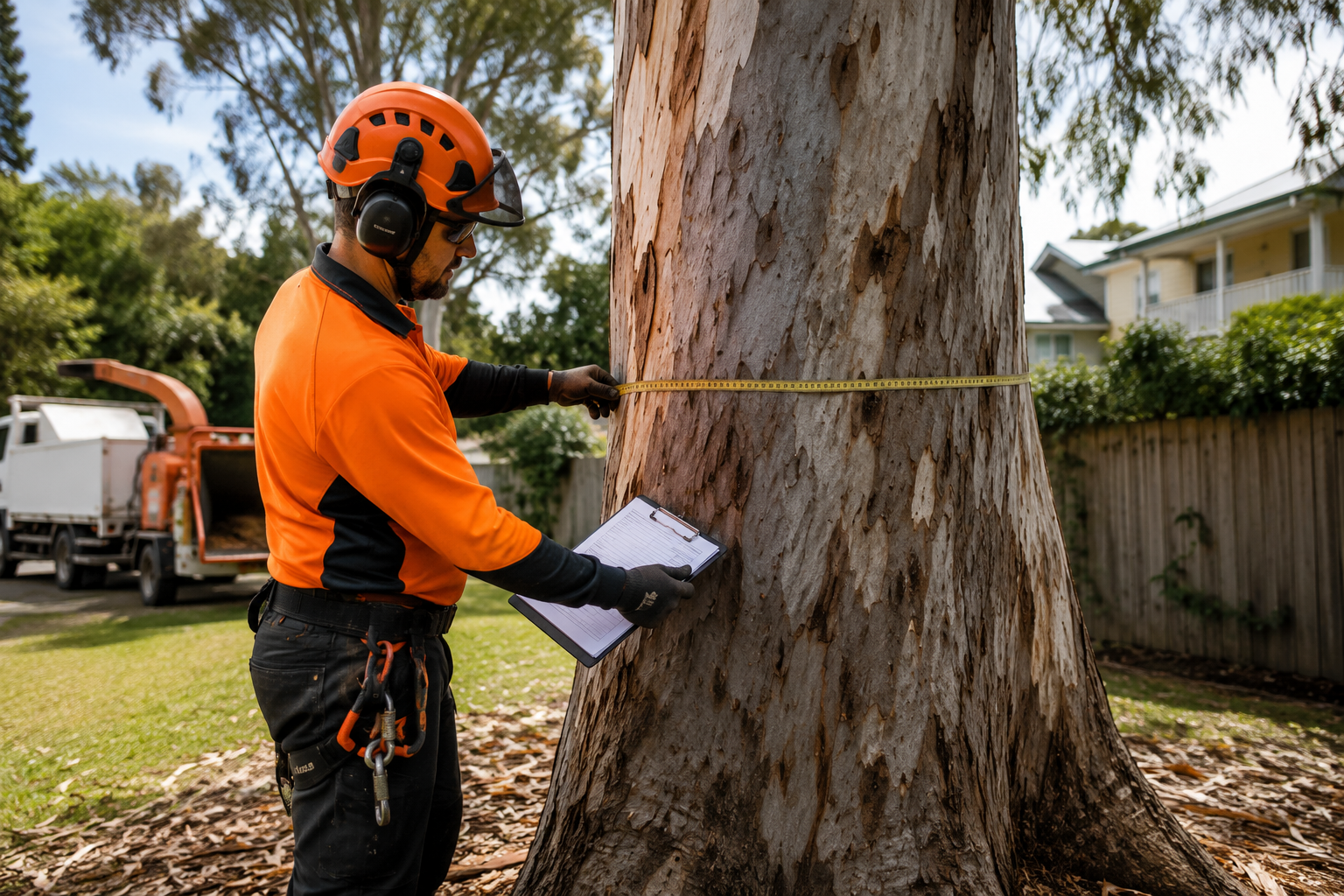
An AQF Level 5 consulting arborist visits the property, measures the tree (trunk circumference at 1.3m, canopy spread, height), identifies the species, assesses health and structural condition, and determines the retention value. This is the foundation document for the rest of the application.
Step 3 — Arboricultural Impact Assessment
For applications involving native species, significant trees, or trees in mapped overlays, a full Arboricultural Impact Assessment (AIA) compliant with Australian Standard AS 4970-2009 Protection of Trees on Development Sites is normally required. The AIA documents the tree’s significance, retention value, and the justification for removal or impact.
Step 4 — Application Submission
The completed application goes through council’s planning portal (PD Online for BCC, MyCity for some councils, MyCouncil for others). Application fees range from around $400 for simple removals to $1,000+ for complex multi-tree applications.
Step 5 — Council Assessment
Councils typically take 6 to 10 weeks to assess tree removal applications. They may request additional information, conduct a site inspection, or require neighbour notification depending on the scale. Decisions can include approval, approval with conditions (e.g. replacement planting), or refusal.
Step 6 — Removal Within Approval Window
Approvals typically include a window (often 12 months) during which the work must be carried out. After the window expires, you generally need to re-apply. The work itself must be carried out by a competent operator — councils can require evidence of insurance, safety documentation and arboricultural qualifications.
Emergency & Storm-Damaged Tree Removal
What about a tree that’s already split, leaning over your house after a storm, or is genuinely about to fall? Every SEQ council provides a mechanism for emergency removal — but it’s not “remove now, never tell council”. The typical process is:
- If there is imminent risk to life — engage a qualified arborist immediately and remove the immediate hazard. Take photographs before removal showing the tree’s condition.
- Within 7 days — submit an after-the-fact notification to council with the arborist’s written assessment, photographs of the original tree condition, and documentation of the work done.
- For non-imminent damage — even storm-damaged trees still typically need an application before removal, just expedited.
Our 24/7 emergency tree response service handles after-storm callouts across all six SEQ councils — and we know each council’s emergency notification process by heart. Storm damage is a high-risk time for unauthorised removal claims, so getting an arborist on site quickly to document the original condition is critical.
Penalties for Unauthorised Tree Removal
The maximum penalties for removing protected vegetation without approval are genuinely substantial:
- Brisbane City Council (NALL) — Up to $13,345 per tree for an individual; up to $66,725 for a corporation.
- Logan City Council — Up to $80,000+ depending on the scale and ecological significance.
- State Vegetation Management Act — Penalties for unauthorised clearing of regulated vegetation can exceed $700,000 plus rehabilitation orders for cleared areas.
- Commonwealth EPBC Act — Penalties scale into the millions of dollars and can include criminal prosecution for protected ecological communities.
Councils take complaints seriously — a neighbour who notices a missing tree can lodge a complaint, and councils have aerial imagery, satellite mapping, and previous building applications to cross-reference whether a tree was there last month or last year. The “I’ll deal with consequences later” approach almost always costs more than going through the process upfront.
Why Most Applications Need an Arborist Report
Councils don’t expect homeowners to have arboricultural expertise — but they do expect formal applications to be supported by professional documentation. A qualified AQF Level 5 consulting arborist brings several things councils need:
- Independent professional opinion on the tree’s species, age, health and structural condition
- Quantified assessment of structural risk using accepted methodologies (Visual Tree Assessment, Tree Risk Assessment Qualification protocols)
- Compliance with Australian Standard AS 4970-2009 for impact assessments
- Compliance with Australian Standard AS 4373-2007 for pruning recommendations
- Photographic documentation
- Justified retention/removal recommendation
A weak or amateur arborist report is one of the most common reasons applications get refused or sent back. The 6-week assessment window starts again when an application is sent back for missing information — so getting it right first time matters. Our team prepares council-ready arborist reports across all SEQ council areas.
Common Mistakes Property Owners Make
- Assuming “my property, my tree” — Ownership of the land does not grant ownership of vegetation rights. Councils regulate trees regardless of who owns the underlying property.
- Confusing “private property” with “unregulated” — All six SEQ councils regulate vegetation on private property under various overlays.
- Trusting an unqualified opinion — A landscaper, a neighbour, or even a council customer service officer’s casual opinion is not a binding determination. Get it in writing from a qualified consulting arborist before you commit.
- Cutting it down “before the rules apply” — Pre-emptive clearing to avoid future restrictions is increasingly prosecuted under retrospective enforcement provisions.
- Ignoring overlays not visible on the title — Vegetation overlays don’t appear on Form 1 title searches; they’re on the planning scheme mapping layer.
- Skipping the AIA — A cheap arborist quote without a proper AIA almost always costs more in the end through application refusals.
- Using a non-qualified operator — Even if approval is granted, an unqualified operator carrying out the work can void your insurance and trigger council enforcement against you personally.
Frequently Asked Questions
Do I need council approval to remove a tree from my own backyard in Brisbane?
If the tree’s trunk circumference is 400mm or more measured at 1.3m above ground, or the tree is on Brisbane’s Significant Tree Register, or the tree is in a Vegetation Protection Overlay, then yes — you need an approval under the Natural Assets Local Law 2003. Smaller trees and many ornamental species are typically exempt.
How long does a council tree removal application take?
Most SEQ councils take 6 to 10 weeks to assess a tree removal application from submission. Complex applications involving native species, multiple trees, or trees in mapped overlays can take longer. Plan for 8 weeks minimum and apply well before you need the work done.
Can I remove a tree that’s dead or clearly dying?
Most councils exempt removal of dead trees from approval requirements — but you typically need an arborist’s written confirmation that the tree is genuinely dead (not just stressed or partially dieback). Take photographs before removal and keep the arborist’s statement on file.
What if a storm has already damaged the tree and it’s about to fall?
Emergency removal of imminent-threat trees is permitted under most council frameworks. Engage a qualified arborist immediately, photograph the tree’s condition before removal, and notify council with the arborist’s statement within 7 days. Don’t attempt emergency removal yourself.
Does the rule apply if the tree is on a neighbouring property but overhanging mine?
Overhanging branches are governed by both common law (the right to prune branches that cross the property boundary, back to the boundary) and council rules (which still apply to the tree itself). You can prune overhanging branches but you generally cannot remove the tree without the property owner’s consent — and they still need council approval.
What’s the penalty if I just remove a tree without approval?
Maximum penalties range from $13,345 per tree under BCC’s NALL to substantially higher under state Vegetation Management Act provisions, and can scale into hundreds of thousands of dollars for clearing of mapped regional ecosystems. Penalties depend on the scale and ecological significance of what was cleared.
Can I remove a tree if it’s damaging my house’s foundations or sewer pipes?
Demonstrated structural damage to built infrastructure is one of the standard exemption categories — but you generally need engineering evidence of the damage, not just suspicion. An arborist’s report combined with a plumber’s or structural engineer’s report is the typical evidence package.
Do these rules apply to council-owned trees on the verge?
Yes — verge trees are usually council-owned and councils control their management entirely. Removal requires a council application initiated by the homeowner, and council typically only approves removal where the tree is dead, dangerous, or causing demonstrated infrastructure damage.
Need Help With a Council Application?
Tree removal applications in South-East Queensland aren’t difficult — but they are detailed, and the consequences of getting it wrong are significant. The right approach is straightforward: get a qualified consulting arborist on site early, identify the rules that apply to your specific block, scope the work properly, and submit a council-ready application package.
Dynamic Tree Solutions handles council tree removal applications across all six SEQ council areas — Brisbane City Council, Logan City Council, Ipswich City Council, Moreton Bay Regional Council, Scenic Rim Regional Council, and Gold Coast City Council. Our AQF Level 5 consulting arborists prepare the full application package including arboricultural impact assessment, planning scheme analysis, and council liaison through to approval.
Phone 1300 2DYNAMIC (1300 239 626) for a free, no-obligation assessment of whether your tree removal needs council approval — and what the path forward looks like.
